

News & Updates
Stop Child Abuse-Newsletter January 2024
Posted on
  Violence Against Children Violence Against Children Reported in the Media for January 2024 At PEaCE/ECPAT Sri Lanka, we have recently improved our documentation system by introducing expanded classifications. We have transitioned our data collection process to align with UNICEF’s International Classification of Violence against Children (ICVAC) standards. This comprehensive framework allows for a detailed categorisation of information gathered from various media. As a result of this upgrade, our analysis now spans across several pages due to the wealth of data captured. In order to help readers navigate through this extensive documentation, we have prepared a concise summary highlighting key points that may be of particular interest. This summary provides an accessible overview of the main findings for easier comprehension and engagement with the information presented. Categories of Child Abuse In January 2024, ECPAT Sri Lanka’s Media Monitoring Team uncovered a disturbing trend of violence against children, as reported by various media outlets. The team documented 55 incidents involving a total of 60 child victims across six main categories of abuse. Sexual abuse emerged as the most prevalent form of violence, comprising 19 cases. Neglect of children was a close second category with eight reported cases, followed by physical abuse with six cases. Gender disparities were also apparent in the data, with 22 female victims and 21 male victims identified in January. The gender of 17 victims remained unspecified. Among the victims, 21 were in the 11 to 14 age group, while 13 were in the 15 to 18 age group. Types of Child Abuse Incidents 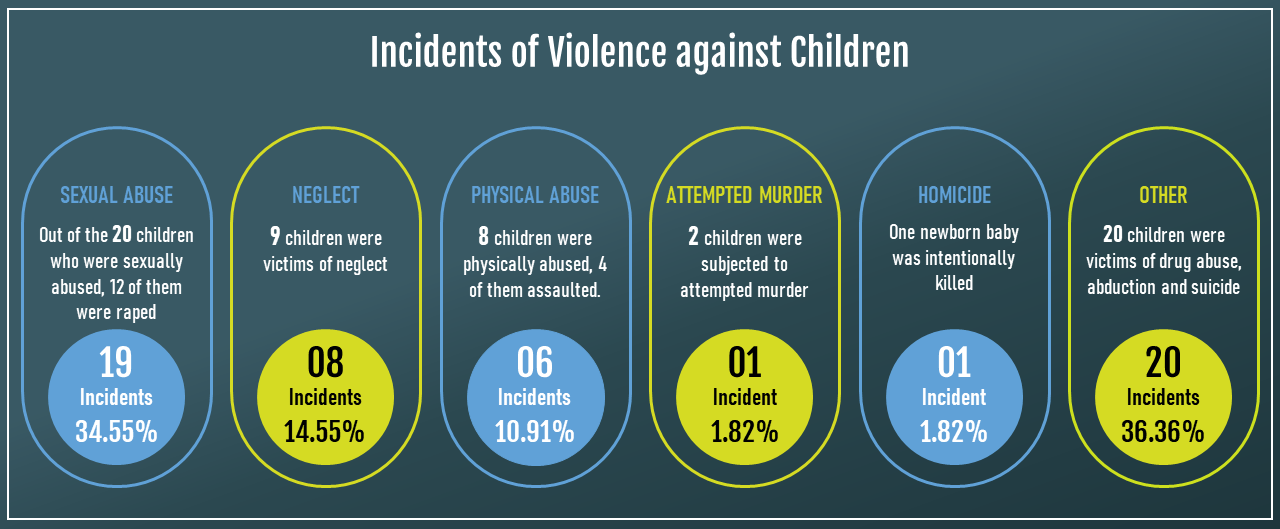 In the analysis of data on violence against children reported by the media in January 2024, it is clear that sexual abuse emerged as the most prevalent form of violence, with 20 victims accounting for nearly 35% of total incidents. Following closely behind was neglect, with eight reported instances making up 15% of the total incidents. Physical abuse was the next most common, with six reported incidents representing 11% of the total. Two cases of attempted murder and one case of homicide were also reported, accounting for roughly 5% of total incidents. Neglect was further highlighted with nine victims, comprising 15% of the total reported incidents. Additionally, unspecified forms of violence, not categorised above, constituted the highest percentage of reported incidents, with 20 cases making up 33%. Overall, there were total of 55 total victims, which represented 100% of the reported incidents. In the analysis of data on violence against children reported by the media in January 2024, it is clear that sexual abuse emerged as the most prevalent form of violence, with 20 victims accounting for nearly 35% of total incidents. Following closely behind was neglect, with eight reported instances making up 15% of the total incidents. Physical abuse was the next most common, with six reported incidents representing 11% of the total. Two cases of attempted murder and one case of homicide were also reported, accounting for roughly 5% of total incidents. Neglect was further highlighted with nine victims, comprising 15% of the total reported incidents. Additionally, unspecified forms of violence, not categorised above, constituted the highest percentage of reported incidents, with 20 cases making up 33%. Overall, there were total of 55 total victims, which represented 100% of the reported incidents. 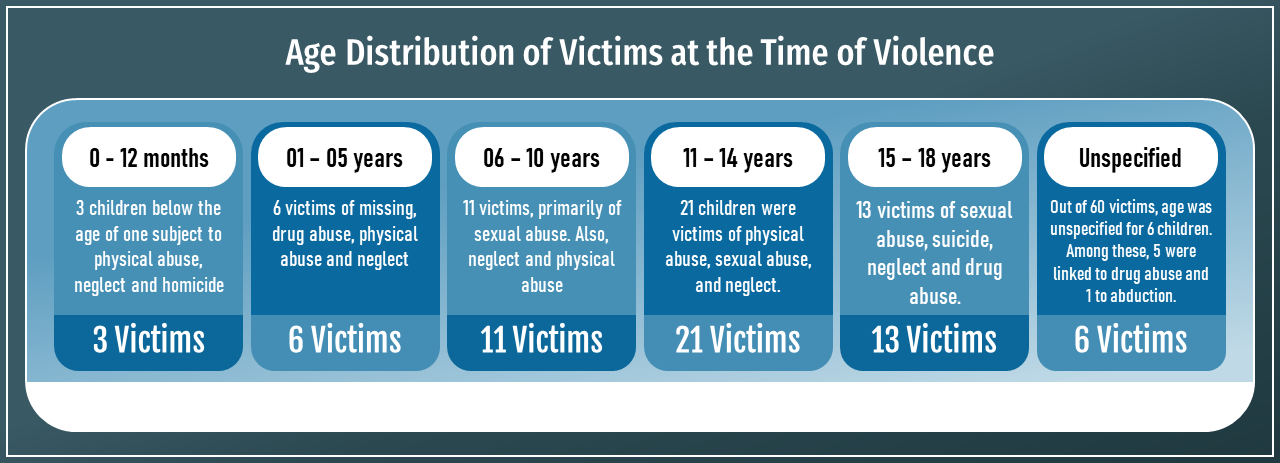 Out of the 60 child victims affected by violence, it is evident from the data that there is a noticeable distribution among various age groups. Children aged 11 to 14 years bear the brunt of these incidents, making up 35% of the total cases. About 22% of victims belong to the age group of 15 to 18 years. Children aged 6 to 10 years follow closely behind, accounting for 18% of the incidents. The age group 1 to 5-year-olds make up 10%. Infants from newborn to 12 months constitute 5% of the cases. There were also instances where the age was not specified, which represents 10% of the total cases. Out of the 60 child victims affected by violence, it is evident from the data that there is a noticeable distribution among various age groups. Children aged 11 to 14 years bear the brunt of these incidents, making up 35% of the total cases. About 22% of victims belong to the age group of 15 to 18 years. Children aged 6 to 10 years follow closely behind, accounting for 18% of the incidents. The age group 1 to 5-year-olds make up 10%. Infants from newborn to 12 months constitute 5% of the cases. There were also instances where the age was not specified, which represents 10% of the total cases. 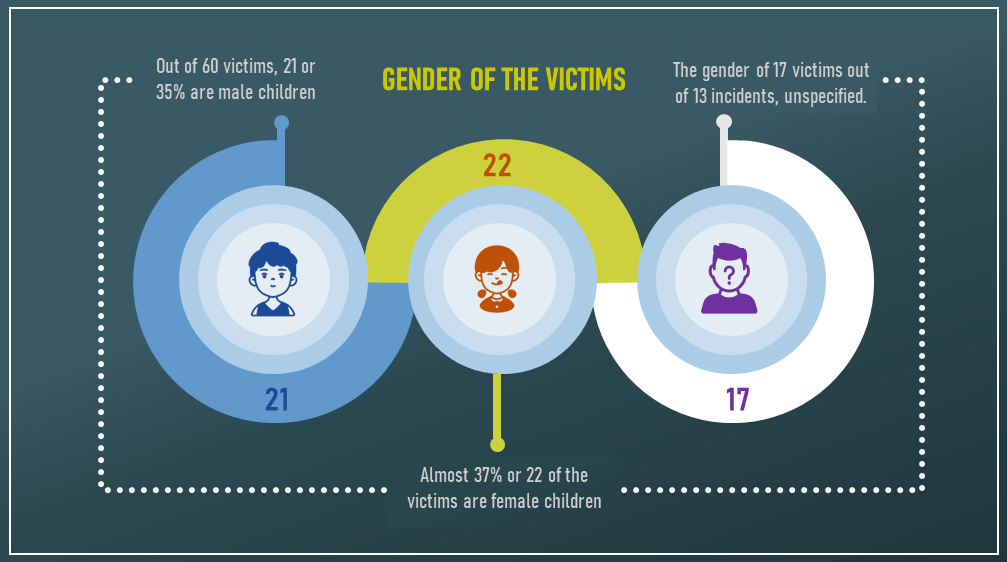 As per media reports from January 2024, the breakdown of incidents involving victims based on gender is as follows: there were 21 cases involving male victims, constituting 35% of total cases, and 22 cases involving female victims, making up 37% of the total. Furthermore, there were 17 instances where the gender of the victims was unspecified, accounting for 28% of the reported incidents. In terms of the number of victims, there were slightly more female victims reported than male victims (22 cases versus 21 cases). As per media reports from January 2024, the breakdown of incidents involving victims based on gender is as follows: there were 21 cases involving male victims, constituting 35% of total cases, and 22 cases involving female victims, making up 37% of the total. Furthermore, there were 17 instances where the gender of the victims was unspecified, accounting for 28% of the reported incidents. In terms of the number of victims, there were slightly more female victims reported than male victims (22 cases versus 21 cases). 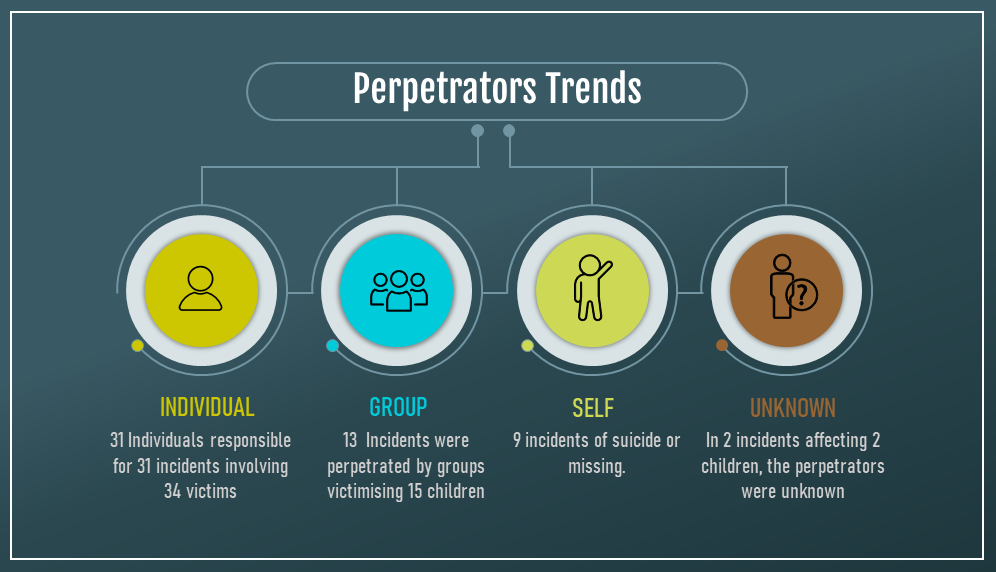 Out of the documented incidents, individuals acting alone were responsible for 31 cases, accounting for 56% of the perpetrators. These individuals included family members, peers or schoolmates, persons with formal authority like teachers, intimate partners, strangers and others. Thereafter 13 cases (24%) involved violations that could be attributed to different groups. These groups were classified as family members, strangers, and individuals with unknown affiliations. In two incidents (4%), the responsible party could not be identified. Sadly, in nine cases (16%), the children themselves were responsible for the self-inflicted harm, which included suicide and going missing. It is also noticed that in 4% of cases, the perpetrator’s identity remained unknown. Out of the documented incidents, individuals acting alone were responsible for 31 cases, accounting for 56% of the perpetrators. These individuals included family members, peers or schoolmates, persons with formal authority like teachers, intimate partners, strangers and others. Thereafter 13 cases (24%) involved violations that could be attributed to different groups. These groups were classified as family members, strangers, and individuals with unknown affiliations. In two incidents (4%), the responsible party could not be identified. Sadly, in nine cases (16%), the children themselves were responsible for the self-inflicted harm, which included suicide and going missing. It is also noticed that in 4% of cases, the perpetrator’s identity remained unknown. 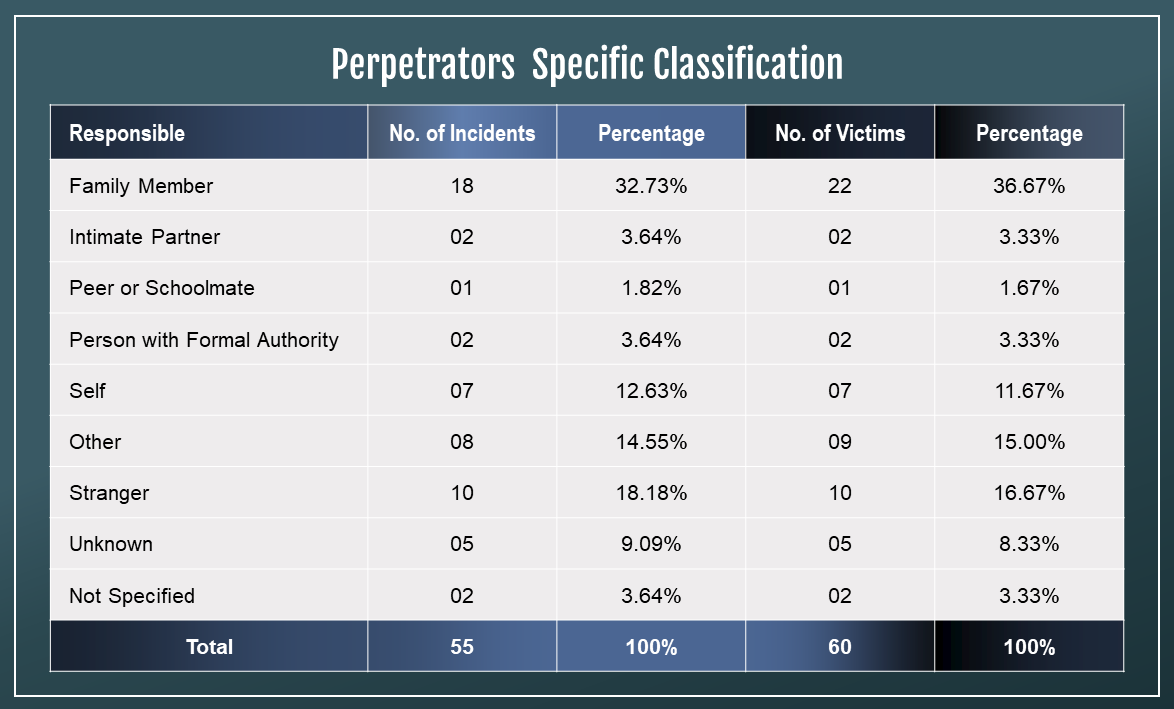 An in-depth examination of data on violence against children exposes notable trends related to the perpetrators involved in the incidents. Out of a comprehensive analysis of 55 cases, family members emerged as the most common perpetrators, accounting for 33% of the total occurrences. Family members in this context surrounded a wide range of relations, including parents, siblings, uncles, aunts, and grandparents. Strangers were identified as the culprits in 18% of the cases, while instances of self-inflicted harm by the children themselves were reported in 13% of the situations. Other categories comprised perpetrators classified as unknown 9%, individuals with formal authority, such as teachers or school personnel 4%, intimate partners of victims 4%, and peers or schoolmates 2%. This breakdown sheds light on the diverse dynamics at play in cases of violence against children. An in-depth examination of data on violence against children exposes notable trends related to the perpetrators involved in the incidents. Out of a comprehensive analysis of 55 cases, family members emerged as the most common perpetrators, accounting for 33% of the total occurrences. Family members in this context surrounded a wide range of relations, including parents, siblings, uncles, aunts, and grandparents. Strangers were identified as the culprits in 18% of the cases, while instances of self-inflicted harm by the children themselves were reported in 13% of the situations. Other categories comprised perpetrators classified as unknown 9%, individuals with formal authority, such as teachers or school personnel 4%, intimate partners of victims 4%, and peers or schoolmates 2%. This breakdown sheds light on the diverse dynamics at play in cases of violence against children. 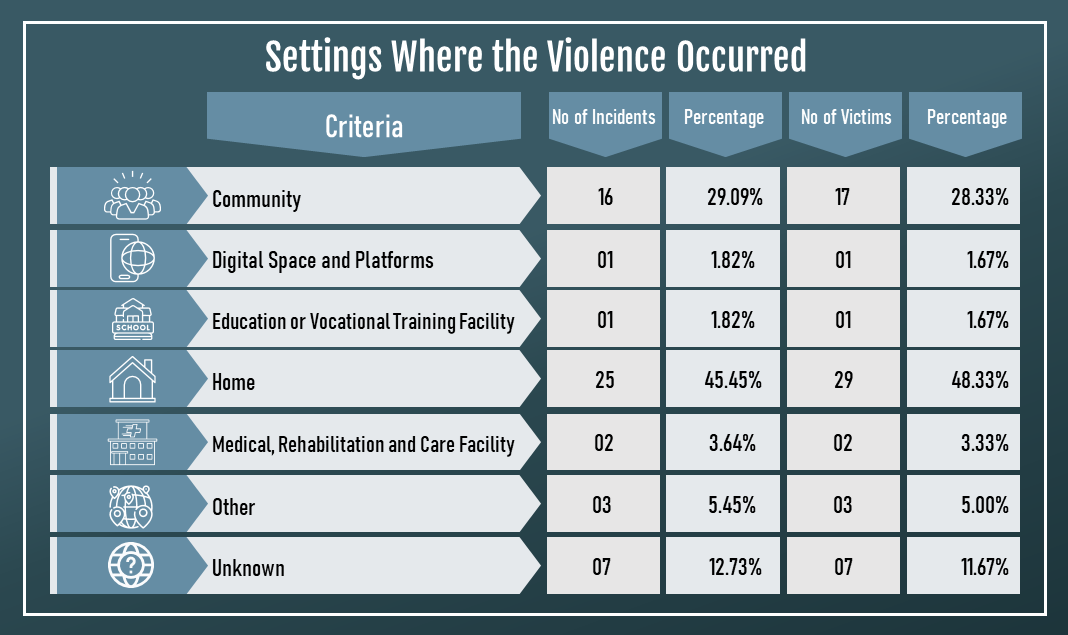 Among the 55 incidents of violence against children reported, the majority occurred in the home setting, accounting for 25 cases (45%). Following this, incidents in a community setting in a public space such as a street, park, place of worship, religious institution, etc. were reported 16 times, making up 29% of the total incidents. The unknown accounted for 7 incidents (13%), while the medical, rehabilitation and care facility setting reported two incidents (4%). Only one incident each was reported in the digital space/platforms setting, as well as the education or vocational training facility setting, both contributing to 2% of the total incidents. Additionally, three incidents (5%) fell under the category of ‘Other’. Among the 55 incidents of violence against children reported, the majority occurred in the home setting, accounting for 25 cases (45%). Following this, incidents in a community setting in a public space such as a street, park, place of worship, religious institution, etc. were reported 16 times, making up 29% of the total incidents. The unknown accounted for 7 incidents (13%), while the medical, rehabilitation and care facility setting reported two incidents (4%). Only one incident each was reported in the digital space/platforms setting, as well as the education or vocational training facility setting, both contributing to 2% of the total incidents. Additionally, three incidents (5%) fell under the category of ‘Other’. 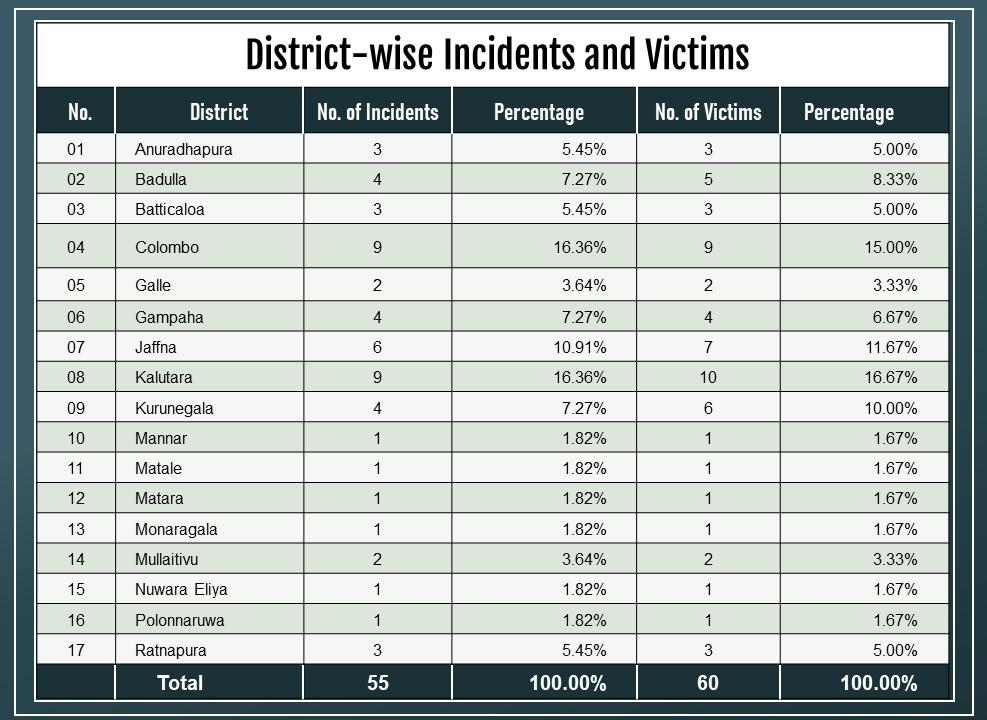 The data on incidents of violence in various districts is analysed as follows: Colombo and Kalutara districts had the highest number of incidents, attributed to nine cases, making up 16% of the total incidents. Jaffna districts followed closely behind with six cases, representing 10%. Badulla, Gampaha, and Kurunegala districts each had four cases, contributing to 7% of the total incidents. Anuradhapura, Batticaloa, and Ratnapura districts recorded three cases each, accounting for 5% of the total. Galle and Mullaitivu districts reported two cases each, while Mannar, Matale, Matara, Monaragala, Nuwara Eliya, and Polonnaruwa had one case each, indicating 2% of the total incidents. The data on incidents of violence in various districts is analysed as follows: Colombo and Kalutara districts had the highest number of incidents, attributed to nine cases, making up 16% of the total incidents. Jaffna districts followed closely behind with six cases, representing 10%. Badulla, Gampaha, and Kurunegala districts each had four cases, contributing to 7% of the total incidents. Anuradhapura, Batticaloa, and Ratnapura districts recorded three cases each, accounting for 5% of the total. Galle and Mullaitivu districts reported two cases each, while Mannar, Matale, Matara, Monaragala, Nuwara Eliya, and Polonnaruwa had one case each, indicating 2% of the total incidents. |