
Events
Decade of Dignity Report; A Strategic Vision for Eradicating Modern Slavery in the UK Organised by NWG
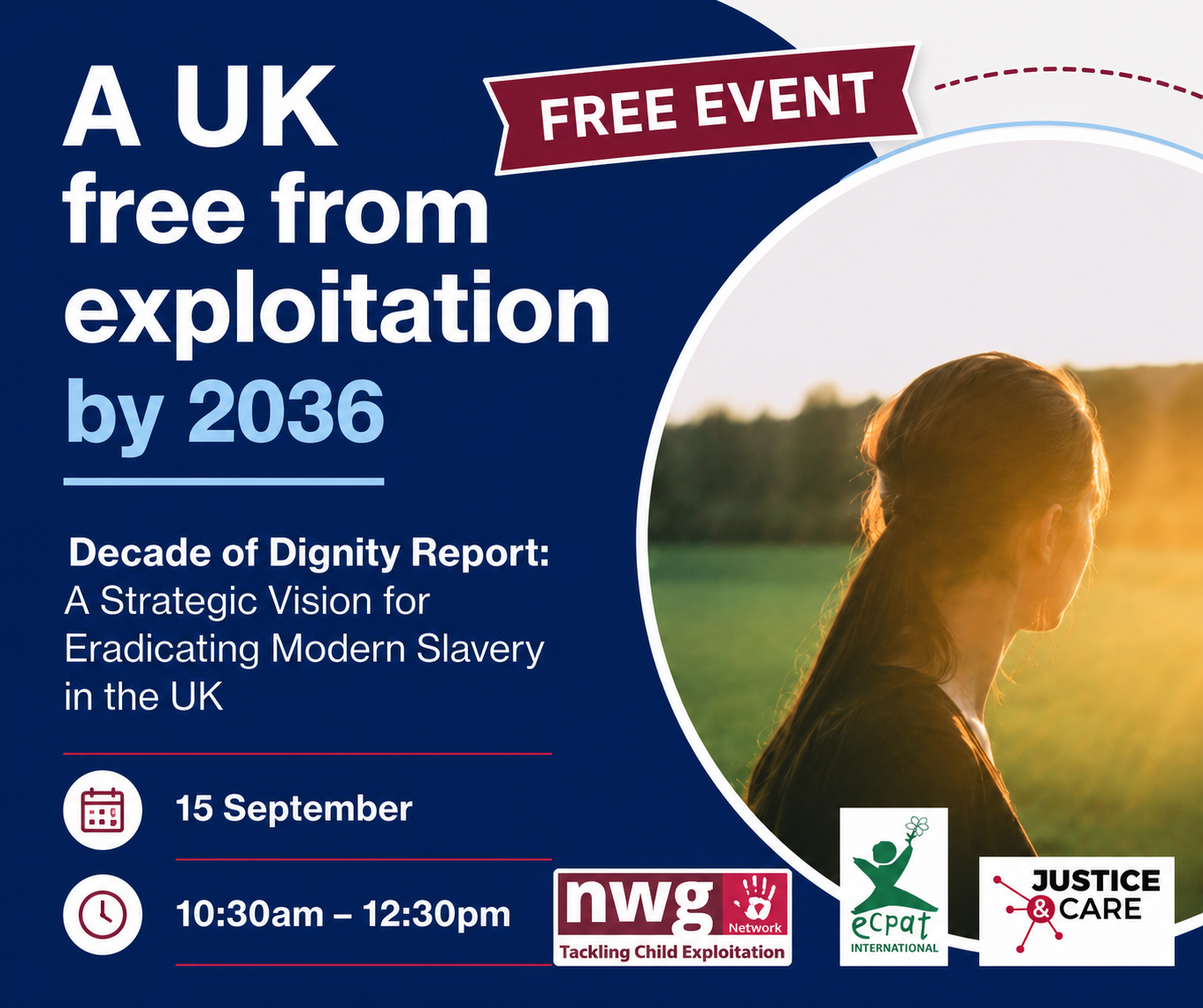
NWG Network is delighted to provide another platform to share the final report “Decade of Dignity: A Strategic Vision for Eradicating Modern Slavery in the UK”.
More than 130,000 people are living in modern slavery across the UK today.
Without urgent action, exploiters will continue to operate in what has been described as a ‘low risk,
high reward’ environment.
That’s why leaders from across the anti-slavery sector gathered at the House of Commons on 8th June 2026 to mark the launch of ‘Decade of dignity’ – a strategic vision for ending exploitation and human trafficking in the UK.
NWG will be hosting this event to promote awareness of the resource and amplify the key messages in the report to support the fight against Modern Slavery in the UK
Despite the introduction of the Modern Slavery Act 2015, the report finds that the UK’s response has faltered due to weak enforcement, fragmented policing, ineffective business regulation, and policies that restrict support for survivors.
The consortium warns that current systems are failing victims and allowing criminal networks to thrive.
“We produced this strategic vision because, after the government published its modern slavery action plan, it did not follow through on the harder requirement: a long-term, coordinated approach with real accountability,” said Andrew Wallis OBE, CEO of anti-slavery charity Unseen and report co-author.
“No structure has been put in place to own delivery or take responsibility for falling behind in the fight against exploitation. That absence has direct consequences. Without sustained focus, enforcement weakens and survivor support fragments. Exploitation remains profitable because nothing structurally disrupts it.
“This consortium stepped in to fill a void that should never have been left, and to make a clear political point: without a serious, sustained government strategy, the system fails the people it exists to serve.”
Four priorities for a decade of action
The report outlines four key priorities for reform:
1.Stronger corporate accountability: introduce a new law within two years to replace Section 54 of the
Modern Slavery Act with legally binding duties on businesses, including mandatory human rights due diligence,
bans on goods linked to forced labour, and penalties for non-compliance.
2.A tougher criminal justice response: make modern slavery a core policing priority, with sustained investment in specialist teams, financial investigations, and advanced data to disrupt criminal networks.
3.A survivor-centred system: reform support to provide long-term, needs-based care for survivors, removing legal and policy barriers to recovery, and ensuring access to safe housing and legal advice.
4.A national strategy for child exploitation: create a UK-wide, cross-government strategy to replace fragmented approaches, with a unified framework grounded in children’s rights.
Decade of dignity is an important contribution to the national conversation – and a call for long-term, systemic change. We look forward to working with partners across the sector to turn this vision into reality.
Together, we can build a future where every person is free from exploitation and able to live with dignity.
AGENDA – Times TBC
NWG Network intro
Laura Duran from ECPAT
Tatiana Gren-Jardan – Head of Policy and Advocacy, Justice and Care
Panel Q&A
Thank you and close
Learning outcomes and objectives if:
Learn about the key messages from the report, understand how they are relevant to your area of work and, in turn, how you can support transforming this vision into a reality……
Who is the course intended for?
Everyone who has a commitment to and interest in eradicating Modern Slavery in the UK, including professionals and volunteers at operational and strategic levels from all safeguarding sectors.
Speaker blogs:

Laura Durán Head of Policy, Advocacy and Research at ECPAT UK.
Laura has extensive experience working against the exploitation of children, leading ECPAT UK’s research and policy work on trafficked children’s rights for the past 7 years. Laura has a master’s degree in international human rights law and co-authored a book on child trafficking from Bristol University Press. She led on several research projects with academic institutions and co-authored over 13 reports. She represents the organisation in various government and civil society working groups and forums, contributing expertise to enhance the UK’s response to child trafficking. Prior to this, Laura managed ECPAT UK’s capacity building programme, led on international projects and trained thousands of frontline professionals on identifying, responding to and safeguarding potential victims of child trafficking. She has worked directly supporting unaccompanied children in the UK and has over 10 years’ experience as an educator in public programmes.
About ECPAT UK
Every Child Protected Against Trafficking (ECPAT UK) is a leading children’s rights organisation working to protect children from trafficking and transnational exploitation. We support children everywhere to uphold their rights and to live a life free from abuse and exploitation. ECPAT UK has campaigned for more than 20 years to protect children, and prevent child trafficking, modern slavery and transnational child abuse. We published the first research on child trafficking in the UK and continue to lead the campaign for the rights and protection of trafficked children. Our work aims to bring about positive change for children by lobbying for improved policy and legislation, directly supporting child victims of trafficking, raising awareness of modern slavery, producing child-focused research and delivering quality, rights-based training on child exploitation. For more information on our training programme, visit https://www.ecpat.org.uk.

Tatiana Gren-Jardan Head of Policy and Advocacy at Justice and Care
Tatiana is a leading specialist in the field of modern slavery and human trafficking, with more than two decades of experience across international organisations, government, and the non‑profit sector. Her work has consistently focused on strengthening policy, improving victim support, and advancing coordinated, evidence‑based responses to exploitation.
Since 2019, Tatiana has served as Head of Policy and Advocacy at Justice and Care, where she leads the organisation’s strategic engagement with government, policymakers, and sector partners. Her work centres on shaping national approaches to prevention, victim support, and criminal justice reform.
Prior to this, Tatiana held senior roles including Director of Strategy for the UK’s Independent Anti‑Slavery Commissioner, where she oversaw the development and implementation of the Commissioner’s strategic priorities, and Director of the Human Trafficking Foundation, leading cross‑sector collaboration and policy development to strengthen the UK’s response to trafficking.
Tatiana began her career in 2004 with the International Organisation for Migration (IOM) in Moldova, where she worked for seven years in roles including Prevention Coordinator and Public Relations Coordinator. This early work laid the foundation for her enduring commitment to combating exploitation and supporting those affected by it. She is a Chevening Scholar and holds a Master’s degree in Politics, Security and Integration from University College London (UCL).