Violence Against Children Reported in the Media for March 2024
At PEaCE/ECPAT Sri Lanka, our Media Monitoring team documented various incidents of child abuse and neglect reported across different media platforms in March. We have compiled comprehensive data for our readership’s awareness using our recently expanded classifications aligned with UNICEF’s International Classification of Violence against Children (ICVAC) standards.
Types of Child Abuse Incidents In March, we identified 85 incidents involving 156 child victims. The predominant type of violence was cases of sexual abuse, with 26 cases and 28 victims. Negligence followed with 23 cases and 72 victims. Additionally, there were 18 cases of physical abuse affecting 37 children. Our data revealed gender distinctions among the victims: 51 children’s genders remain unknown, while 56 were male and 49 were female. Age-wise, the majority of victims—53 children—were in the 15-18 age bracket, followed by 33 victims in the 11-14 age group.
However, the age of 48 victims was not specified. Geographically, Gampaha district reported the highest number of cases (11), whereas Puttalam district had the highest number of victims (33). According to the Chairman of the National Child Protection Authority, there has been a rise in child abuse cases in the Western, North Western, and Sabaragamuwa provinces. Despite the prevalence of physical punishment, neglect, and mental abuse, reporting in these areas remains slow.
From 1st January to 30th April this year, 872 complaints of child neglect and 632 complaints of cruelty to children were received under the Children and Young Persons Ordinance. The Chairman noted a 95% progress rate in police procedures related to physical punishments and sexual assaults, including taking statements, referring victims to forensic doctors, and reporting to the courts.  In the analysis of data on 85 child abuse cases that were reported by the media during March, sexual abuse emerged as the most prevalent form of violence, accounting for 26 incidents, which is nearly 30.6% of all cases. Negligence was the second most common, with 23 reported cases involving 72 victims, representing a little over 46% of the total victims. Physical abuse followed, with 18 incidents resulting in 37 victims, accounting for approximately 23.7% of the total victims. Additionally, 4 cases of homicide were reported, which amounted to 4.7% of the total cases. In the analysis of data on 85 child abuse cases that were reported by the media during March, sexual abuse emerged as the most prevalent form of violence, accounting for 26 incidents, which is nearly 30.6% of all cases. Negligence was the second most common, with 23 reported cases involving 72 victims, representing a little over 46% of the total victims. Physical abuse followed, with 18 incidents resulting in 37 victims, accounting for approximately 23.7% of the total victims. Additionally, 4 cases of homicide were reported, which amounted to 4.7% of the total cases.
Other forms of child abuse reported in March included trafficking, abduction, drug abuse, and suicide. Notably, drug abuse was significant, with 8 cases representing 9.4% of the total incidents and resulting in 9 child victims. There were also 2 cases each of abduction and suicide and one case each of child trafficking and a missing child. Overall, the comprehensive data collection highlights the various types of abuse children face, with sexual abuse, negligence, and physical abuse being the most frequently reported. The detailed categorisation and percentages provide a clear overview of the incidents reported in March. 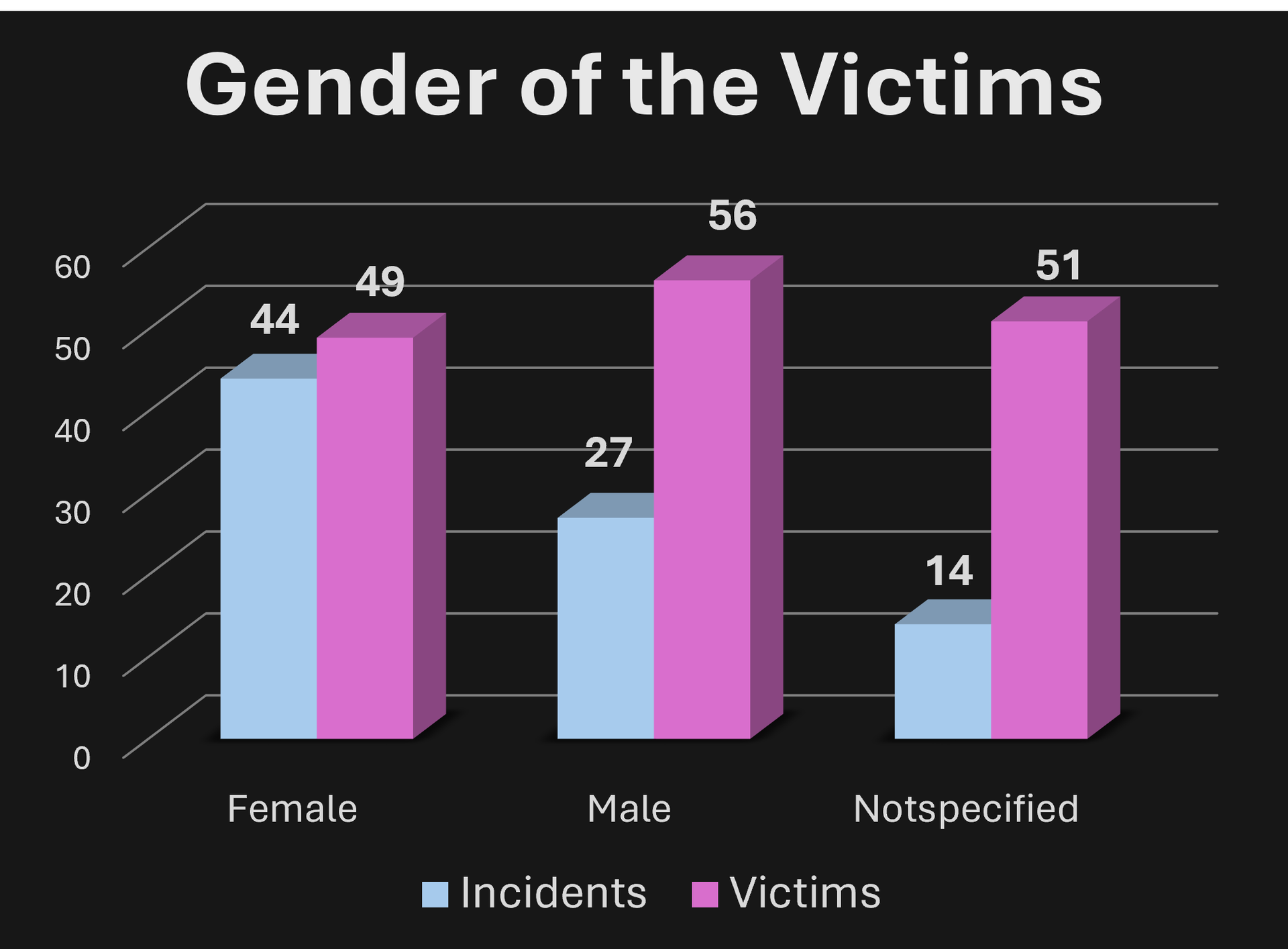 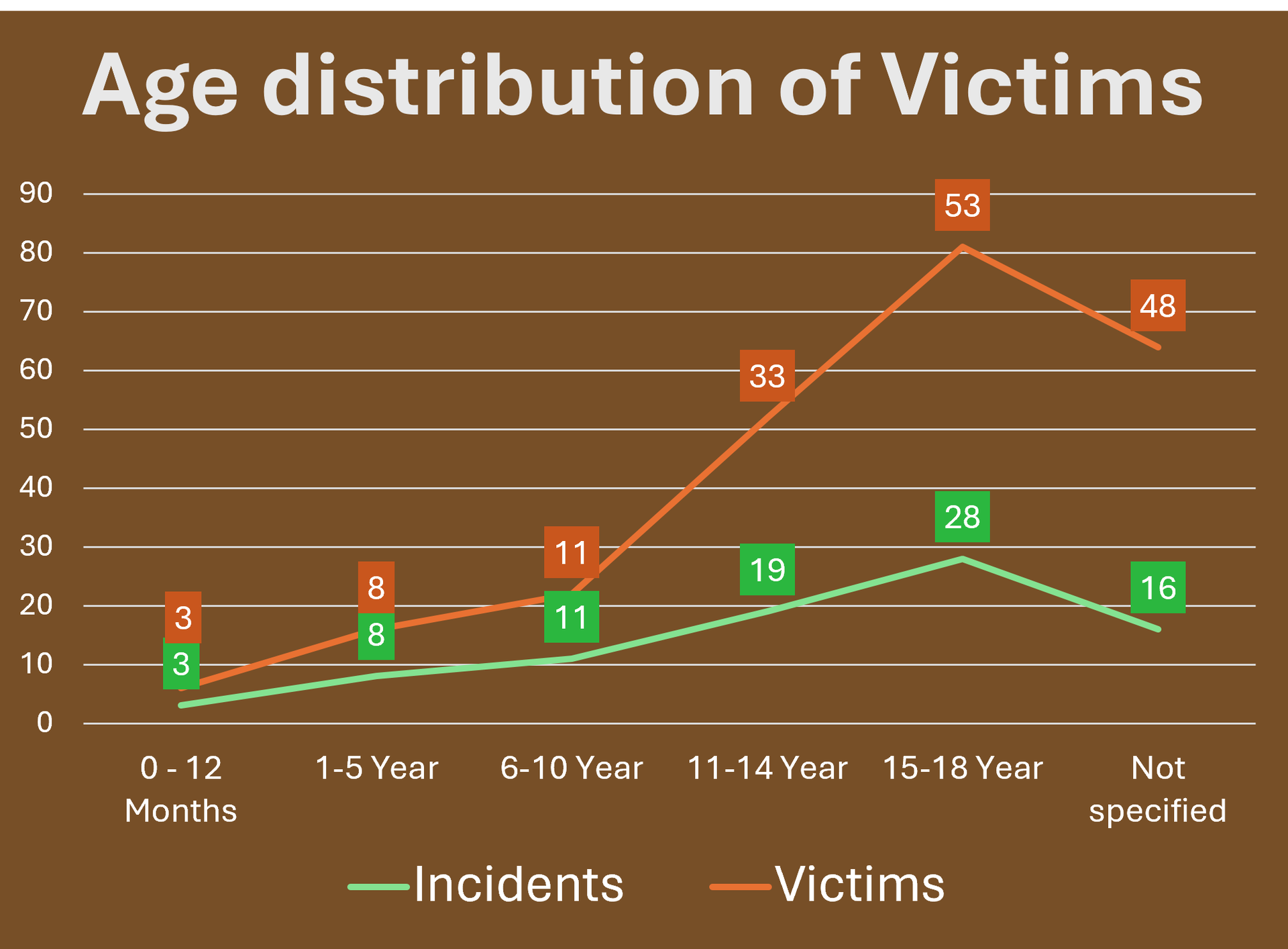
Gender Distribution of Reported Victims As per media reports during March, the breakdown of incidents involving child victims based on gender is as follows: male victims were involved in 27 incidents, accounting for 36% of the total number of victims, with 56 male children affected. Female victims encountered 44 incidents, representing 31% of the total, with 49 female victims affected. Additionally, there were 51 victims whose gender was not specified, making up 33% of the total reported victims.
Age Diversity Among the Victims At the Time of Violence Out of the total child victims of abuse reported in March, the age distribution is as follows: Children aged 15 to 18 years were the most affected, with 53 victims accounting for nearly 34% of the total. Following this, 33 victims were between the ages of 11 to 14, constituting 21.15% of the total. Additionally, 11 victims were aged 6 to 10 years, making up 7.05% of the total, while 8 victims were between the ages of 1 to 5 years, representing 5.1%. Three victims were 12 months old or younger, accounting for 2%. The age of 48 victims remains unspecified in the reports. 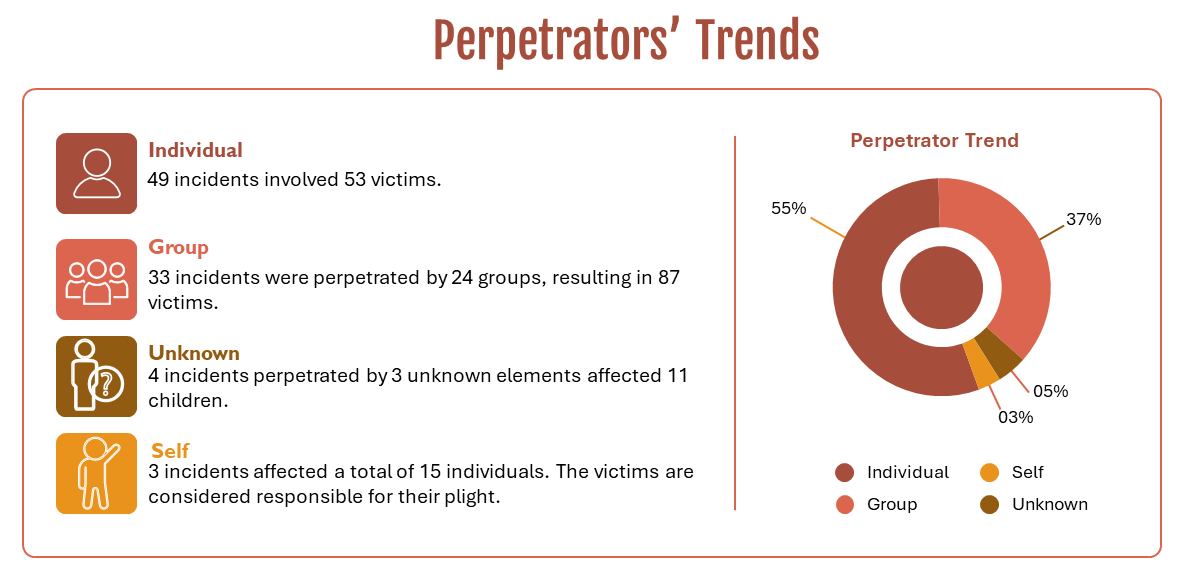 The analysis of perpetrator trends in the reported cases has revealed four main classifications, which account for most incidents. These classifications include individual cases, group-related incidents, cases involving unknown perpetrators, and self-inflicted cases. The analysis identified 49 incidents involving 53 victims. This category alone accounted for a little over 55% of the total incidents, highlighting the significant impact of individual perpetrators on the overall statistics. Incidents involving groups accounted for a notable portion of the total cases. The analysis of perpetrator trends in the reported cases has revealed four main classifications, which account for most incidents. These classifications include individual cases, group-related incidents, cases involving unknown perpetrators, and self-inflicted cases. The analysis identified 49 incidents involving 53 victims. This category alone accounted for a little over 55% of the total incidents, highlighting the significant impact of individual perpetrators on the overall statistics. Incidents involving groups accounted for a notable portion of the total cases.
There were 33 reported incidents perpetrated by 24 separate groups, resulting in 87 victims. The analysis also revealed cases where the identity of the perpetrators remained unknown. There were 4 such incidents that have affected 11 children, contributing to 10% of the total abuse incidents. Tragically, some incidents fell under the ‘Self’ category, where the victims themselves ended up harming themselves. There were 2 such incidents, which produced 2 victims. 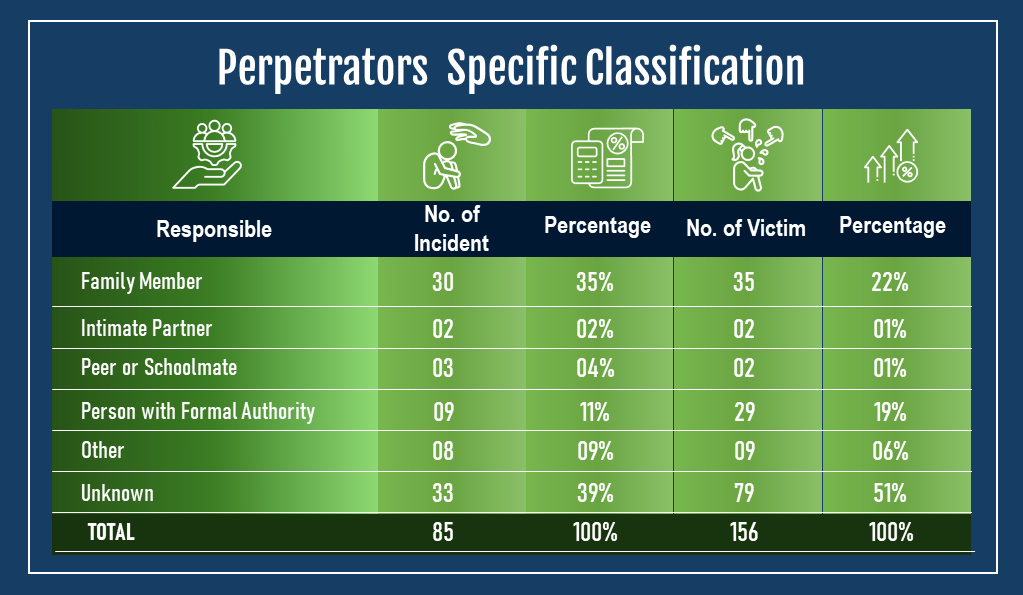 In analysing the specifics of perpetrators, it is notable that the majority remain unknown, accounting for approximately 51% of all cases. This group has produced 79 victims out of the total 156, which corresponds to 39%. These incidents are spread across 33 separate incidents. It is particularly concerning that the majority of victims were impacted by perpetrators whose identities remain unknown. Family members are the second most common category of perpetrators. In analysing the specifics of perpetrators, it is notable that the majority remain unknown, accounting for approximately 51% of all cases. This group has produced 79 victims out of the total 156, which corresponds to 39%. These incidents are spread across 33 separate incidents. It is particularly concerning that the majority of victims were impacted by perpetrators whose identities remain unknown. Family members are the second most common category of perpetrators.
They are responsible for 22.4% of the total 156 victims, with 30 incidents reported, translating to 35% of the victims. Intimate partners were involved in two incidents, resulting in two victims. Other perpetrators, not specifically categorised, accounted for 8 incidents, which resulted in 9 victims and therefore, reported as 9% of the total child abuse incidents. Perpetrators who were classified as either peers or schoolmates and who committed child abuse comprised 4% of incidents or 3 such cases that were reported. These incidents produced 2 victims as a result. Perpetrators with formal authority were responsible for 18.5% or 29 victims. There were nine incidents involving such individuals. 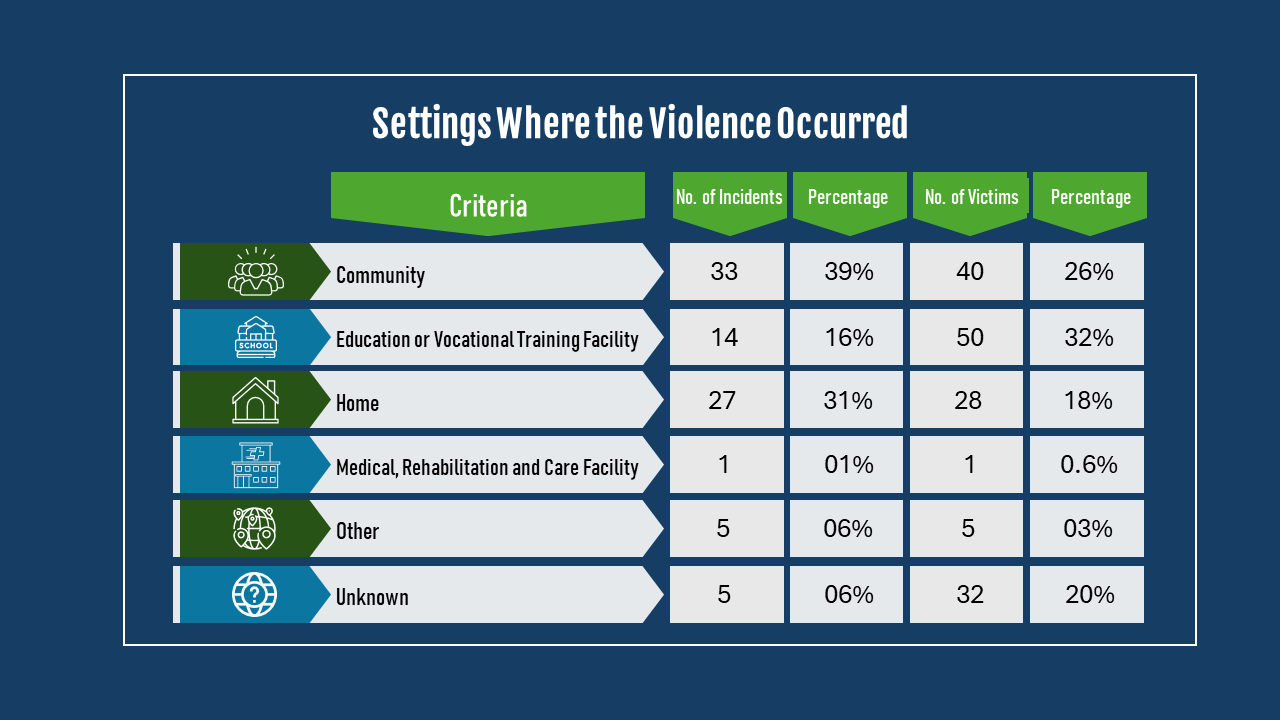 When analysing the locations or the settings where the crime would have occurred, the majority of the victims were victimised in places such as schools or educational settings such as vocational training facilities, for instance. Out of the total number of cases, 14 of these incidents had occurred in educational settings. Following closely were 40 victims that emerged from 33 separate incidents that had taken place in familiar settings such as the victim’s own community. Incidents that have occurred at home amounted to 27 and produced 28 victims as a result. This constituted 31% of the total. Unfortunately, the report also indicated that 20% of the cases had occurred under unknown circumstances, and though 5 incidents were reported, this has accounted for 32 victims that have emerged from this figure. When analysing the locations or the settings where the crime would have occurred, the majority of the victims were victimised in places such as schools or educational settings such as vocational training facilities, for instance. Out of the total number of cases, 14 of these incidents had occurred in educational settings. Following closely were 40 victims that emerged from 33 separate incidents that had taken place in familiar settings such as the victim’s own community. Incidents that have occurred at home amounted to 27 and produced 28 victims as a result. This constituted 31% of the total. Unfortunately, the report also indicated that 20% of the cases had occurred under unknown circumstances, and though 5 incidents were reported, this has accounted for 32 victims that have emerged from this figure. 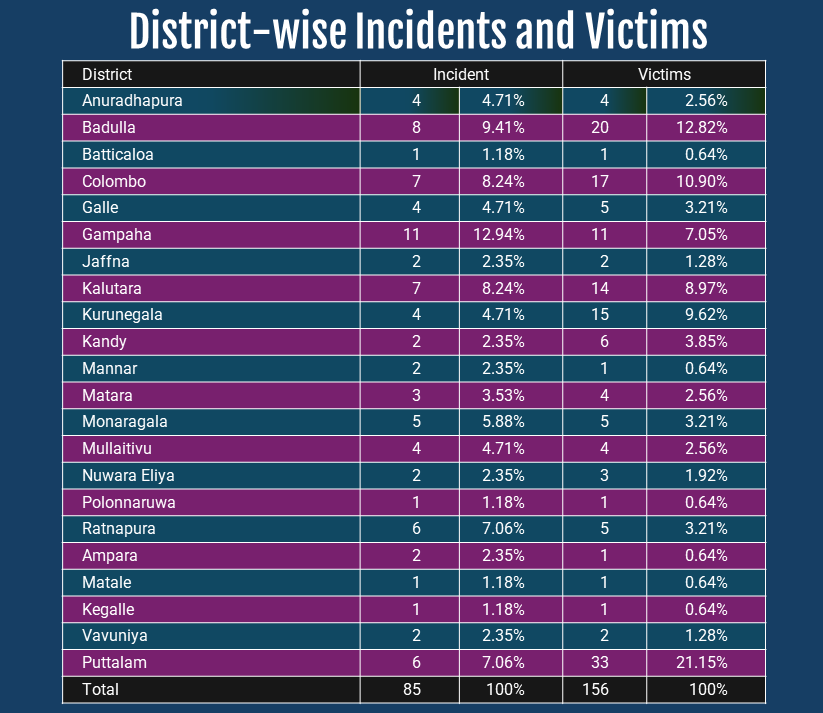 The data on incidents of child abuse in various districts for March is analysed as follows: Gampaha district reported the highest number of cases, with 11 incidents, making up nearly 13% of the total cases. Badulla district recorded 8 incidents, which is 9.4% of the total. Both Colombo and Kalutara districts reported 7 instances each, accounting for 8.2%. Monaragala district reported 5 incidents, contributing 5.8%. Polonnaruwa, Kegalle, Batticaloa, and Matale districts each showed the least incidents, with 1 case each contributing 1.2% of the total. When considering the number of victims in each district, Puttalam had the highest number, with 33 out of 156 victims reported from 6 incidents, making up 21% of the total victims. The data on incidents of child abuse in various districts for March is analysed as follows: Gampaha district reported the highest number of cases, with 11 incidents, making up nearly 13% of the total cases. Badulla district recorded 8 incidents, which is 9.4% of the total. Both Colombo and Kalutara districts reported 7 instances each, accounting for 8.2%. Monaragala district reported 5 incidents, contributing 5.8%. Polonnaruwa, Kegalle, Batticaloa, and Matale districts each showed the least incidents, with 1 case each contributing 1.2% of the total. When considering the number of victims in each district, Puttalam had the highest number, with 33 out of 156 victims reported from 6 incidents, making up 21% of the total victims.
Ratnapura district also reported 6 incidents, accounting for 7%. Anuradhapura, Galle, Kurunegala, and Mullaitivu districts reported 4 incidents each, accounting for 4.7% of the total. Matara district reported 3 cases of abuse, making up 3.5%. Ampara, Jaffna, Kandy, Mannar, Nuwara Eliya, and Vavuniya districts reported 2 instances each, contributing to 2.3% of the total. Trincomalee, Hambantota, and Kilinochchi districts did not report any incidents of violence against children in March.      
PEaCE/ECPAT Sri Lanka
39/4, Jayasinghe Road,
Colombo 6
Sri Lanka |